Showing posts with label Beaten Rice Flakes. Show all posts

Tuesday, September 9, 2014

Kanda Poha ~ Savory Snack made with Beaten Rice Flakes ~ Aval Upma

Kanda poha is a classic snack from Maharashtra ( a state  in the western region of India). Kanda = onion and poha = beaten rice flakes in Marathi language. This classic is a favorite of mine and I am surprised that dish has managed to elude this space for so long. The only explanation I can think of is that I usually make this for weekend breakfast and weekends are also the time when I usually do not take pictures for the blog especially around breakfast time :)

Like any other dish, poha too has a lot of regional variations. My sister in law lives in Pune and tells me that people in that region add some roasted peanuts along with grated coconut to their poha. I have tried a lot of variations of poha including the ones I mentioned above and even one version of poha topped with sev and I have to admit that I have yet to find one that I don't like :) Every variation of poha tastes delicious in its own way :) If you are planning poha for your weekend breakfast or even for a quick evening snack, give this version a try and enjoy this easy tasty snack :)  


Click here for a printable view of this recipe

Ingredients and Method to make Kanda poha
3 cups medium thick beaten rice flakes/ poha/ aval 
1 large red onion cut fine ( pyaaz/ vengayam)
2 Tbsp oil
3/4 tsp mustard seeds ( rai/ kadagu)
3/4 tsp cumin seeds ( jeera/ jeeragam)
3 Thai or Indian variety green chilies cut fine ( or to taste) ( hari mirch/ pachai molagai)
10 - 15 small curry leaves or 8 to 10 large ones torn into small pieces ( kadipatha/ karvapillai )
1/4 tsp turmeric powder ( haldi/ manjal podi) 
Salt to taste ( namak / uppu)
1 tsp sugar (shakkar/ sakkarai )
3 to 4 Tbsp finely chopped cilantro ( coriander leaves/ hara dhania/ kothamalli)

Optional garnish
2 to 3 Tbsp freshly grated coconut ( or frozen thawed to room temperature) (nariyal/ thengai poo)
1 to 2 Tbsp roasted peanuts (mungphali/ kadalai )

Serve with lemon wedges (nimbu/ elimbicham pazham) ( optional)

Place beaten rice flakes/ poha in a colander or strainer and rinse under cold water for a few seconds. Allow to drain completely for 10 to 15 minutes.

Heat oil  on medium heat in a heavy bottomed pan. Add mustard seeds, when the seeds begin to splutter add cumin seeds. When the cumin begins to sizzle, add green chilies and curry leaves and stir a couple of times.

 Add onions and sauté until onions turn translucent.  Add turmeric powder and stir once or twice. 


Add rinsed and drained beaten rice flakes/ poha and mix well. Add salt to taste, sugar and mix again. 
Close with a lid, lower heat to low to medium low heat, cook rice flakes/ poha for a minute or two until the poha heats through and the flavors mingle.Garnish with cilantro/ coriander leaves and serve hot with lemon wedges.

You can also add grated coconut and/ or roasted peanuts for garnish for this poha.  

The lemon wedges are optional, If you like a little lemony taste in your poha, you can sprinkle a few drops just before serving or on your plate.I like it both ways, sometimes with a little lemon juice and sometimes without, depending on my mood that day :)

Serves approx 2 to 3

Read more ...

Tuesday, October 8, 2013

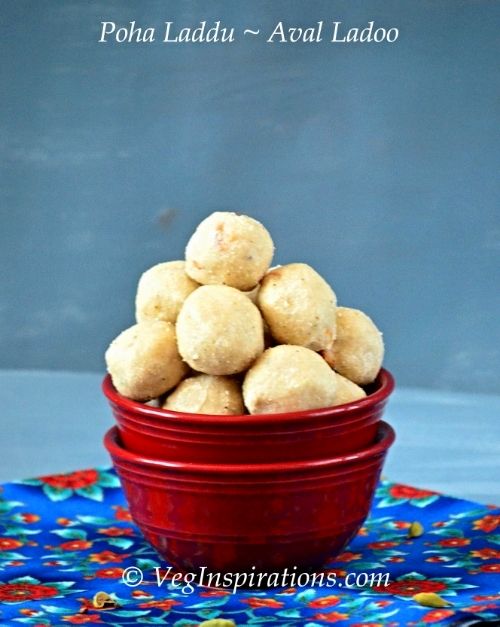
Easy Aval ladoo ~ Poha laddu ~ Indian sweet with Beaten rice flakes ~ With Stepwise pictures

Did the title of the post make you go, " Hmmmm.... Poha in a ladoo ?" believe me, you aren't the only one. I was quite a skeptic about this combination until I tried it myself.  Before I made this ladoo, poha in my home was used in a host of savory dishes, like "Batata poha/ kanda poha ", " Limbu aval/ lemon flavored poha" and dosas such as "this tomato aval dosa " etc. The only sweet version of aval/ poha that I used to make was vella aval (poha sweetened with jaggery). So when a friend first mentioned aval ladoo I was quite skeptical. Yet I was curious enough to want to try it and I have to say I was pleasantly surprised at how awesome the ladoo tasted.


 Easy Poha Laddu ~ Aval Ladoo ~ Indian sweet made with beaten rice flakes

 Since then I have made this ladoo many times, especially recently. My in laws are here with us now, and my father in law, like me, adores sweets. That is all the reason I need to make sweets a lot more often these days  :) This ladoo has already featured a few times in our home recently and every time I make it, my father in law just loves it.  And really what's not to love,  it is so yum that I can never stop at just one :) And the best part is that this ladoo hardly takes any time to put together, it is so quick and easy. There is just no fuss, no syrup or consistency to worry about, it is just fail proof. So if you are looking for a quick and easy Indian sweet for the festive season, or as a treat for you and your family, give this ladoo a try and tell me what you think:)

Easy Aval Ladoo-Poha laddu-Indian sweet made with beaten rice flakes

Click here for a printable view of this recipe

Ingredients and Method to make Aval Ladoo
2 cups medium beaten rice flakes/jada poha/ aval
3/4 cup sugar
1/2 cup + 1 tbsp warm clarified butter (ghee/ nei)
2 tbsp broken cashew nuts (kaju)
1/2 tsp green cardamom seed powder (elaichi/ elakkai) 

Dry roast aval/ poha in a heavy bottomed pan on low to medium low heat, until it turns into a creamy brownish color. Keep stirring it frequently so that it roasts evenly. You know it is done when you are able to easily crush a few flakes between your fingers. Remove from heat, spread on a plate and allow to cool thoroughly.


To show the comparison of roasted poha with unroasted one, here is a picture that shows the roasted poha and below you can see the unroasted poha...


In the same pan, heat 1 tbsp of ghee on low to medium heat, add broken cashew and roast slowly until it turns reddish. Remove from heat and keep aside.


Powder the roasted aval until it is mostly fine. The texture should be like fine semolina (fine rava), this way the ladoo gets a little crunch that is delicious and has a bit of rava ladoo like texture to it:)  Place this powdered aval in a large bowl. Powder sugar until fine. Add elaichi powder to the sugar and give it another turn in the blender/ mixer for the two powders to blend. Remove and pour this powdered sugar into the large bowl and mix well.
The copyright of this content belongs to Veginspirations.com


Add roasted cashews/ kaju to the two powders and mix well. Finally add warm clarified butter/ ghee to the powder and mix with a spoon until it gets mixed in well.


Make small gooseberry/ lemon sized balls with the mixture and keep aside.


Store in an airtight container. This sweet does not require any refrigeration and can be stored in your kitchen shelf. Enjoy within a few days if it lasts that long :)

Yielded approx 15 to 18 small lemon sized balls.

Read more ...

Thursday, November 20, 2008

Javarsi Aval Dosai (Sabudana Poha Dosa/ Sago & Beaten Rice Crepes) Gluten Free


There is a story in our household regarding sago crepes. It so happened that quite some time back R and his family had been to a place called Bandipur National Park in India. This is a place where you get to see a lot of wildlife in their natural habitat. So  they have a lot of memories from that place and one of the memories was about how amazing it was to see deer and other wildlife when you looked out of the window at the cabin where they were staying. But in addition to the tales of these animals R and his parents always talk about one more thing from this place.....food....not something you expect someone to remember from their visit to a wild life sanctuary. 

Apparently in the place they were staying, there was this cook who on the day of their arrival offered to make them sago crepes(dosai). When he got it for them they were all completely blown away by the softness and taste of the crepe/dosai they were offered. They happily consumed copious amounts of bite sized little crepes/dosai and remember it until now. When the family sits together and is reminiscing about old times often this tale about their trip to Bandipur followed by the tale of sago dosai is almost always brought up.Unfortunately though none of them thought to take the recipe from that cook and this dosai and its memory has become a legend around our home. 

Sabudana Poha Dosa/ Gluten free Indian crepes photo 91c35a6f-e75d-4696-b352-a127fa77319b_zpsb0ab09b4.jpg

So now whenever I experiment with something in my kitchen and tell R I made it out of the top of my head R suggests to me that maybe I should try my hand at making the sago dosai.He has been ever hopeful that somehow I will be able to put together the ingredients of an item I have never even seen, let alone tried, and will be able recreate the exact same dosai he once enjoyed. What can I say, R is an eternal optimist when it comes to my cooking :-)   He helpfully gave me two clues to help me in my quest for the perfect sago dosai, he told me that that the dosai he had was soft and it had sago in it:-) 

Well that information has led me to experiment with various proportions of sago and other ingredients in dosai, sometimes with disastrous results, and sometimes like this one, when I hit upon something that tasted yum and that we enjoyed.This dosai has been the softest dosai I have had and had a very light and delicate texture and for those who like their dosai to be crunchy when made very thin and kept on the tawa for a bit longer it turned very crunchy too.

My search for the elusive Bandipur sago dosai/ crepe continues and at the very least this search has proven to be very interesting until now and has the fringe benefit of contributing to my collection of recipes in the process.

Javarsi Aval Dosai/ Sabudana Poha Dosa photo c9a5f15f-13d4-4942-b82e-821fd9ec9ca3_zpsa542aa2d.jpg


Ingredients and method to make Sago Rice crepe ( Sabudana Dosai)
1 1/2 cups brown rice (or white raw rice)
1/2 cup sago (sabudana/ Javarsi)
1/2 cup Beaten rice flakes/ flattened rice (jada poha/ aval)
1/2 cup cooked brown rice (or cooked white rice)
salt to taste
A few drops of sesame oil

Wash, drain and soak the rice in water for at least 4 to 5 hours

Soak sabudana in water ( the water should just cover the sabudana) for about 4 to 5 hours

Just before grinding, wash and drain the flattened rice and keep aside.

Grind the rice until smooth adding water as required. It should be free falling but not runny.

Grind the sago,cooked  rice and flattened rice together until very very smooth. Add water as required but keep this sago,cooked rice and flattened rice mixture thicker than the ground rice.

Mix both the ground mixtures together and add salt to taste and mix well.

Heat the tawa/griddle/flat pan on medium heat and when it is hot pour a ladle full of this batter in the center and spread quickly into a thin circle as possible.

Add a few drops of sesame oil on top and let it cook.

Flip over and cook the other side too.

Serve hot with Spice powder (molaga podi)  or chutney  or sambar.

Yields about 12 to 15 dosais (depending on size )

Variation: 
For those of you who like things spicy you could grind a couple of green chillies (or more or less according to taste) with the rice or the sago to spice things up a bit

Notes for Sago rice crepe

I used long grain brown rice( brown basmati) but any type of white raw rice can be substituted in its place.If you use white rice, this dosai will also look whiter and not have the creamish tinge mine had

The batter should be free flowing but thick not runny. For those of you familiar with both idli batter and dosa batter it should be thicker than dosa batter but a little thinner than idli batter.

If the tawa gets too hot the batter will start rolling even as you try to spread into a circle, so try and keep the tawa on a medium heat throughout.


Related Recipes


Read more ...